
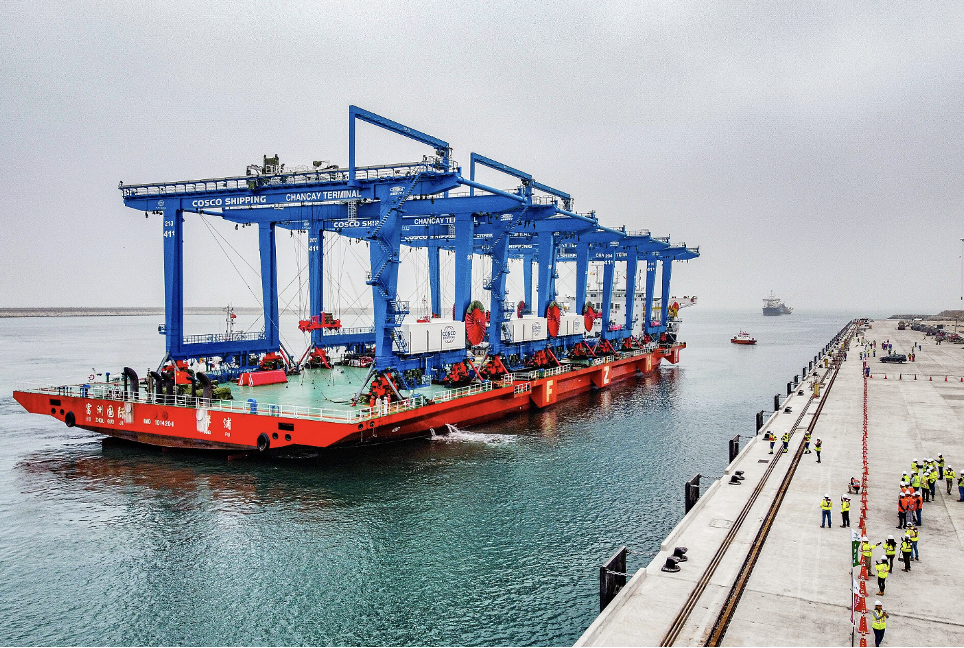
source https://es.wikipedia.org/wiki/Puerto_de_Chancay#/media/Archivo:Inspecci%C3%B3n_a_los_avances_de_obra_del_Terminal_Portuario_de_Chancay_y_presentaci%C3%B3n_de_las_primeras_gr%C3%BAas_el%C3%A9ctricas.jpg
by Andrea Corinaldesi
Introduction
The Chancay Port located in Peru and inaugurated in November 2024, represents one of the two faces of a coin of power projection, that comes not through military might, but through critical infrastructure and global trade routes. The Mega-Port of Chancay is located roughly 80 kilometres north of the Peruvian capital of Lima and it is the first of its kind in South America, capable of welcoming the world’s massive container ships.
The port has been projected and developed by the Chinese state-owned enterprise COSCO Shipping with an initial investment of nearly 1.3 billion of dollars, and it represents a cornerstone of China’s expanding strategy, the Belt and Road initiative (BRI), in Latin America.
The Chancay Port is far from being only a maritime logistics hub, it has quickly become a focal point of intense geopolitical rivalry, capturing the attention of several key regional actors in the area such as Washington and capitals across Latin America.
An Economic and technological milestone
From an economic perspective, the Port revolutionaries the trade between South America and Asia. In fact, previously, South America’s coastal nations lacked adequate facilities, often forcing them to reroute trade through North or Central America. The new Port creates a direct maritime path that reduces shipping time from Peru to Shanghai from 35 days to just 23 days, saving a lot on logistics costs. In general terms, the Peruvian government anticipates that the project will generate approximately 4.5 billion of dollars in annual revenue and create over 8.000 jobs.
Chancay is considered as a pioneer in smart and green shipping. In fact, the facility heavily integrates advanced digital systems, featuring autonomous electric trucks developed by UTOPILOT. Thes trucks, operating without humans use advanced sensors and deep learning ai algorithms to “see” their environment, recognizing along the path obstacles, plan routes, control their movements and avoid collisions. This is really promising, first of all to supercharge the export of critical minerals like lithium and copper, and second to all the Chinese e-commerce platforms like Temu, Shein and Alibaba, looking to expand their influence and trade in Latin America in an easier way.
Domestic controversies
Despite economic promises, the port has also caused several domestic controversies within the State. During construction incidents in the tunnels caused damages to nearby homes, and several environmentalists have raised concerns regarding the impact of excavating on local wetlands and artisanal fishing communities.
For Peruvian sovereignty, the port’s governance has sparked legal battles. Following a recent law modification, COSCO has shipping exclusive rights to operate the port and its tariffs for up to 60 years, all granted by Peru. Additionally, a court ruling controversially excluded the port from oversight by Peru’s public transport infrastructure regulator, by being built with private capital. It is clear how placing such massive, geopolitically sensitive asset under the exclusive control of a foreign state-owned company can create severe risk of external influence, specifically from one of the most powerful and influential state, China.
US and China geopolitical rivalry
What makes the Chancay port so fascinating is how it highlights the escalating strategic competition between the US and China. For over two centuries, the United States has treated Latin America as its own traditional sphere of influence, a geopolitical legacy rooting back to the Monroe Doctrine of 1823.
After China’s deep economic penetration in the region, Washington views it with profound anxiety. US officials have publicly warned that the port grants Beijing great and unchecked access to the continent’s resources. There is also a fear by the Americans that the port could also serve as a hub for Chinese naval vessels and project military power directly into the Americas.
On the other hand, Chinese state pushed back these narratives, stating that the port is strictly commercial, a mutually beneficial project that respects Peru’s sovereignty.
The Peruvian Government, caught in the middle, has attempted to maintain a delicate balancing act, refusing to be placed and forced to choose a side in a new Cold War. Peruvian Foreign Minister Gonzalez-Olaechea addressed US concerns by simply inviting Washington to increase its own investments in the country, pointing also that “the US is like a very important friend who spends very little time with us”.
Regional effects
The broader Latin American neighbourhood has been really reshaped by the geopolitical shockwaves of the Chancay Port; in fact, it poses a direct commercial threat to already established Pacific hubs in Chile, such as the San Antonio and the Port Company of Valparaíso, which were established as the main Pacific ports and will lose a significant portion of their traffic. In response to China’s move, the United States has focused investment efforts in modernizing Chile’s San Antonio port to counterbalance the Chancay’s dominance.
Other nations are racing up in the meanwhile, for example Nicaragua has recently announced plans for a new deep-water port on its Caribbean coast backed by Chinese agreements and Colombia is dredging its Buenaventura port to welcome larger ships.
Conclusion
The Chancay port is a defining case study for contemporary international relations. It shows the dual nature of modern global infrastructure: on the one hand, serving as a vital engine for economic integration, and on the other, functioning as a sensitive friction point for superpower competition.
For Peru, the port is a great opportunity to become South America’s premier logistic hub. It’s a chance for Lima to prove it can strengthen its institutions at home while acting as an independent player abroad, balancing great-power rivalries to its own strategic advantage.
For Peru the port offers an important opportunity to become the premier logistic hub of South America, proving that the Government can strengthen its domestic institutions and, at the same time, be an independent global actor capable of balancing great-power rivalries to its own strategic advantage.
As of today, the real challenge for Latin America is to adapt quickly and navigate this US-China rivalry at the best to extract the economic benefits of foreign investment without losing its political autonomy.